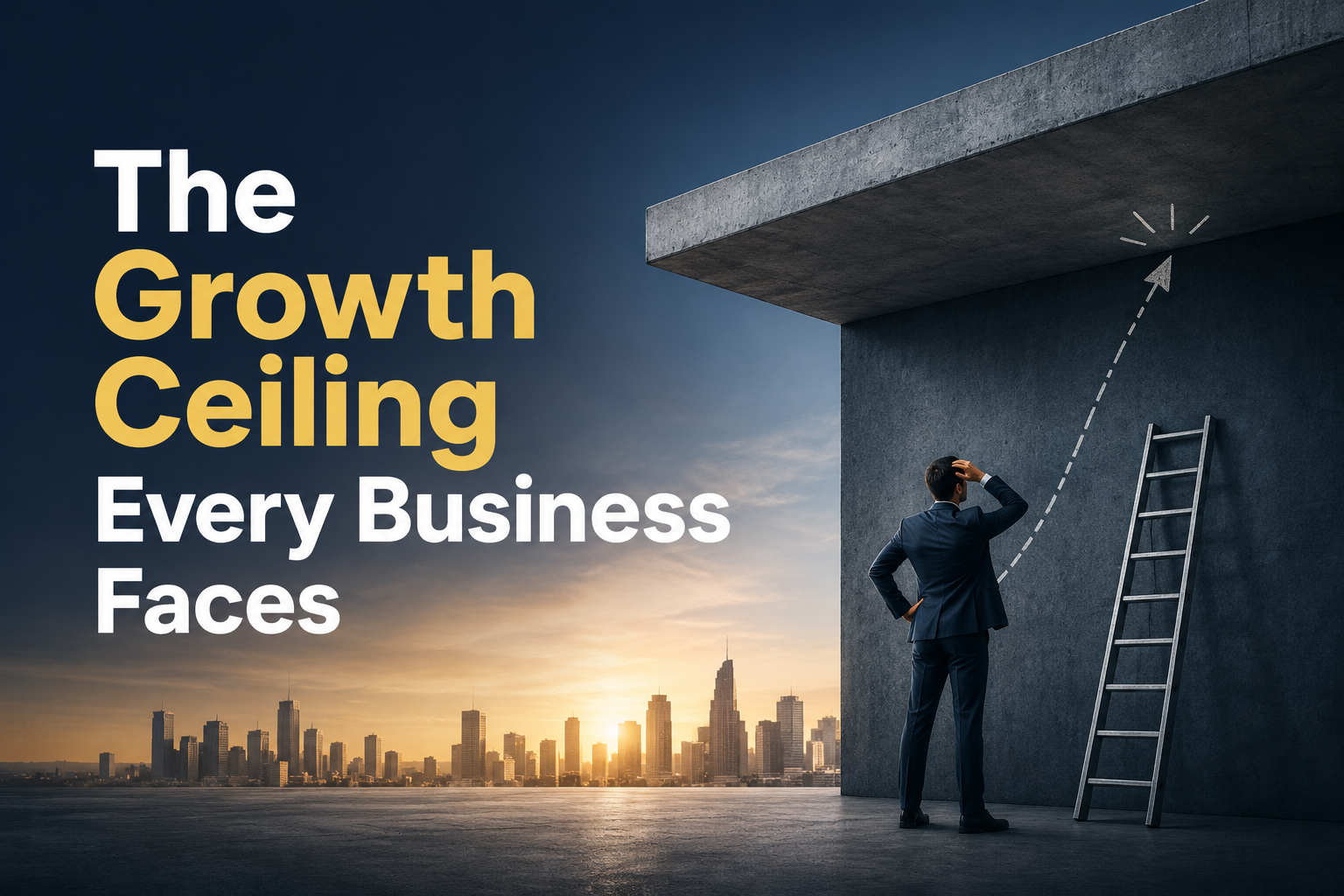

Every business owner dreams of growth.
More customers. Higher revenue. Stronger market presence. Greater impact.
In the early stages, progress often comes quickly. New clients arrive, sales increase, and the future looks promising. Then something unexpected happens.
Growth slows down.
The strategies that once delivered results begin to lose their effectiveness. Revenue plateaus. Teams become stretched. New opportunities seem harder to capture. Despite working harder than ever, the business struggles to move forward.
This is what many experts refer to as the growth ceiling.
The growth ceiling is the invisible barrier that prevents businesses from reaching their next stage of development. While it can be frustrating, the good news is that it is often caused by identifiable challenges that can be addressed with the right strategy.
The real question is: what is holding your business back?
The Danger of Outgrowing Your Systems
One of the most common causes of stalled business growth is outdated systems and processes.
Many businesses begin with simple structures that work well during the startup phase. As the company grows, however, these systems often struggle to keep up with increasing demands.
Tasks that were once manageable become time-consuming. Communication becomes less efficient. Customer service may begin to suffer. Teams spend more time solving operational problems than creating value.
Growth requires systems that can scale.
Businesses that fail to modernize their operations often find themselves trapped by the very processes that helped them succeed initially.
Leadership Bottlenecks Can Limit Growth
In many organizations, growth slows because too much depends on one person.
The founder approves every decision. Employees wait for direction. Critical information remains concentrated at the top.
While this approach may work in the early stages, it becomes increasingly difficult as the business expands.
Successful growth requires leadership that empowers others, delegates effectively, and builds capable teams. Businesses reach new levels when leaders stop trying to do everything themselves and focus on creating systems that allow others to perform at their best.
Sometimes the biggest obstacle to growth is not the market.
It is the inability to let go of control.
Talent Gaps Create Growth Limits
A business can only grow as far as its people can take it.
Many organizations reach a point where the skills that built the company are no longer sufficient for the challenges ahead.
New markets may require specialized expertise. Expansion may require stronger management capabilities. Digital transformation may require technical talent that the organization currently lacks.
This is why talent acquisition, employee development, and continuous learning have become critical business priorities.
The organizations that invest in people are often the ones that break through growth barriers faster than their competitors.
Fear of Change Keeps Businesses Stuck
Growth often requires change.
New technologies. New strategies. New business models. New ways of serving customers.
Yet many organizations resist change because what they have always done feels comfortable and familiar.
The problem is that markets evolve whether businesses are ready or not.
Customer expectations change. Competitors innovate. Technologies advance.
Businesses that fail to adapt risk becoming irrelevant.
Sometimes the greatest threat to growth is not competition.
It is complacency.
Lack of Strategic Direction
Being busy is not the same as making progress.
Many businesses operate without a clear long-term growth strategy. Teams work hard, but their efforts are not aligned toward a common objective.
Without direction, resources become scattered. Opportunities are missed. Priorities constantly shift.
High-growth companies tend to share one characteristic: clarity.
They know where they are going, why they are going there, and what actions are required to get there.
A clear strategy helps businesses focus on activities that generate meaningful results rather than simply staying busy.
Customer Experience May Be Holding You Back
Many businesses focus heavily on acquiring new customers while overlooking the experience of existing ones.
Growth becomes difficult when customers fail to return, referrals decline, or brand loyalty weakens.
Today’s customers have more choices than ever before. They expect quality service, personalized experiences, and consistent value.
Businesses that prioritize customer satisfaction often unlock one of the most powerful growth engines available: repeat business and word-of-mouth referrals.
Sometimes growth is not about finding more customers.
It is about serving current customers better.
Breaking Through the Growth Ceiling
Every business eventually encounters obstacles.
The companies that continue to grow are not necessarily those with the largest budgets or the most resources. They are often the ones willing to identify weaknesses, embrace change, and make strategic improvements.
Breaking through the growth ceiling requires honest reflection.
Ask yourself:
- Are our systems supporting growth or limiting it?
- Is leadership empowering the team effectively?
- Do we have the right talent for the future?
- Are we adapting to market changes?
- Do we have a clear growth strategy?
- Are we delivering exceptional customer experiences?
The answers to these questions often reveal where growth opportunities are hiding.
Conclusion
Every successful business eventually reaches a point where past strategies are no longer enough to drive future success.
The growth ceiling is not a sign that your business has reached its limit. It is often a signal that the next stage of growth requires a different approach.
Whether the challenge lies in leadership, systems, talent, strategy, or customer experience, identifying and addressing these barriers can unlock new opportunities for expansion.
Growth is rarely about working harder.
More often, it is about working smarter, adapting faster, and building a business that is designed to scale.
The question is not whether your business can grow.
The question is whether you are willing to remove the obstacles standing in its way.