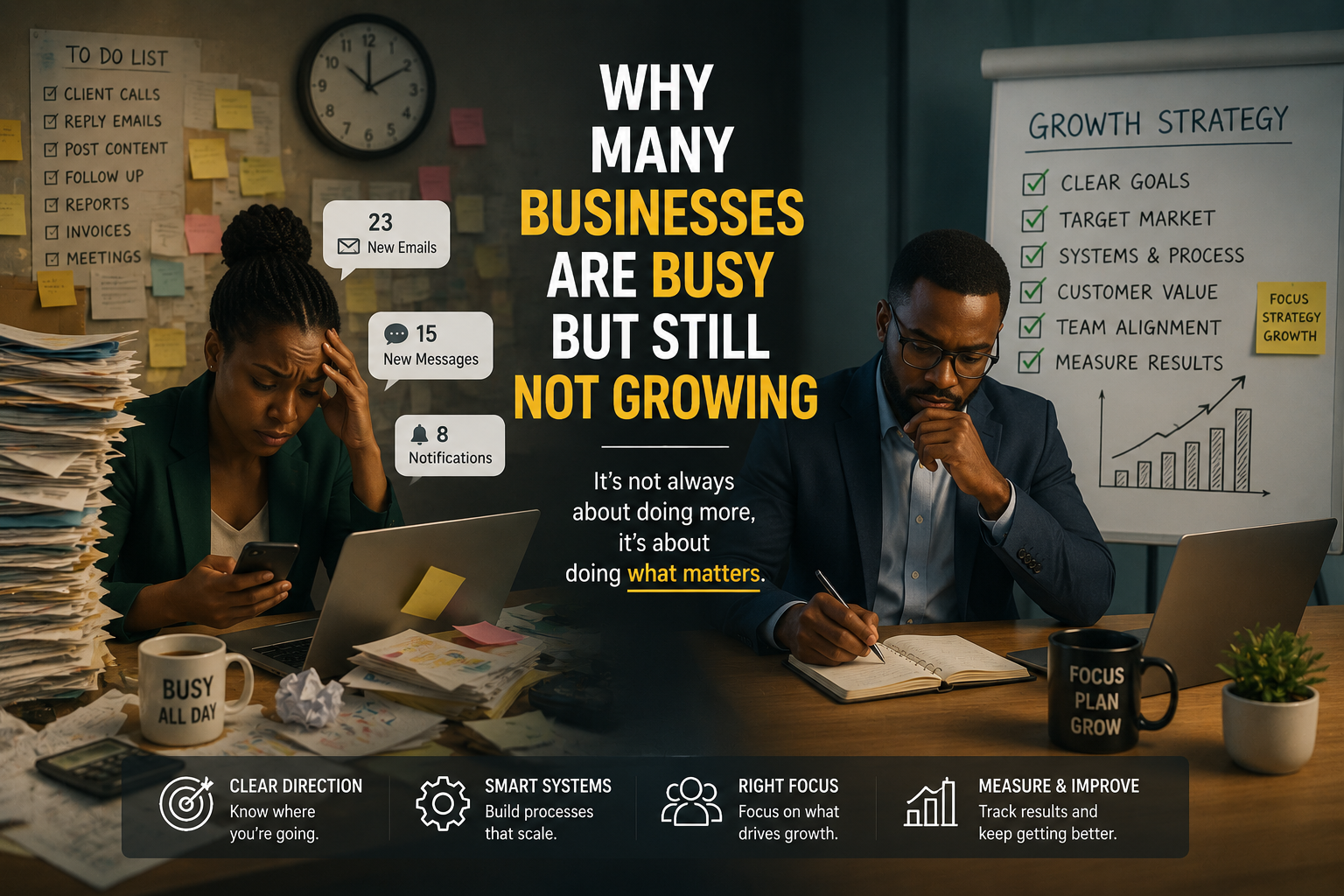

In today’s business world, being busy does not always mean a business is making progress. Many companies operate every day with constant activity, meetings, marketing campaigns, customer conversations, and daily operations, yet they still struggle to achieve real growth. The problem is that activity and productivity are not always the same thing.
A lot of businesses focus heavily on doing more instead of doing what actually moves the business forward. Teams become consumed with replying to messages, posting content daily, attending meetings, and handling small operational tasks while ignoring larger strategic goals that drive long term success.
One of the biggest reasons businesses remain stagnant is the lack of clear direction. Many companies know they want growth, but they do not clearly define what growth looks like. Without measurable goals, businesses often operate reactively instead of strategically. They spend time solving daily problems rather than building systems that create sustainable progress.
Another common issue is chasing every opportunity at once. Some businesses try to target too many customers, launch multiple services, or operate across different markets without focus. While expansion sounds attractive, lack of specialization can weaken brand identity and reduce operational efficiency. Businesses that grow successfully often understand exactly what problem they solve and who they solve it for.
Poor decision making based on trends rather than data also affects growth. Businesses sometimes copy competitors without understanding their own audience or market position. What works for one company may not work for another. Companies that rely on customer insights, performance data, and market research are more likely to make informed decisions that support long term growth.
Leadership also plays a major role. Some businesses struggle not because the market is bad, but because decision making within the organization is inconsistent. Weak communication, unclear priorities, and lack of accountability can slow down progress even when opportunities exist.
Technology has also exposed operational weaknesses in many businesses. Companies that fail to improve systems, automate processes, or adapt to changing customer expectations often fall behind competitors that move faster and communicate better. In today’s environment, efficiency has become a competitive advantage.
Customer retention is another overlooked factor. Many businesses spend heavily on attracting new customers while neglecting the existing ones they already have. Long term growth is often driven more by customer loyalty, repeat business, and strong relationships than by constant customer acquisition alone.
Financial management is equally important. Some businesses generate revenue consistently but still struggle because of poor cash flow planning, unnecessary spending, or lack of reinvestment strategies. Growth requires not only making money but managing it effectively.
The reality is that many businesses are not failing because they lack effort. They are struggling because effort without structure, focus, and strategy rarely produces sustainable results. True business growth usually comes from clarity, consistency, smart systems, and the ability to focus on what matters most.
In business, staying busy can create the illusion of progress. But real growth happens when companies move beyond constant activity and begin operating with purpose, direction, and measurable strategy.